Monday, May 16, 2011

The World Doesn't Care About American Pop Culture (As Much As We Think)

Who the hell are the Kardashians?
When I was about 12 years old, my family took a trip to Paris. To my lasting shame, one of our meals was purchased from McDonald's (and I didn't even have the presence of mind to order a royale with cheese). My younger sisters were too preoccupied with their Mulan Happy Meal toys to care about the culinary travesty that had just taken place.

During my freshman year in college I spent a few weeks in Ecuador and had the pleasure of viewing Steven Seagal's Under Siege 2. I was on a crowded bus, surrounded by live chickens and blown-out speakers and old ladies who were not shy about audible flatulence. Needless to say, I do not have favorable memories of that film.

Most Americans who travel abroad have a similarly sobering tale of American cultural imperialism - Simpsons T-shirts in Guyana, outdated Madonna tunes at a bar in Turkey, Nikes and Starbucks pretty much everywhere. It's obvious that various expressions of American pop culture are making inroads into previously untouched areas. And from there, I guess, one could come to the logical conclusion that these ubiquitous symbols of American prosperity/glamor/awesomeness are threatening to the indigenous cultures. Once the kids get blasted with some Black Eyed Peas, they'll lose their taste for...well, whatever passes for music in their backward-ass country.

Scary stuff - imagine a world where everyone reads Stephanie Meyer, listens to Jason Mraz, and thinks Step Up 3 was a good movie. The soulless corporate media machine of America rolls across the globe, obliterates its woefully over-matched/under-airbrushed competition, and smothers humanity with a brain-deadening tapioca sludge of Survivor, Beyonce, and US Weekly...

There's just one problem with this doomsday scenario. Actually, several billion problems. As in the number of people who don't care that much about the slop Hollywood is pushing. 

In Korea, the domestic entertainment industry is far more influential than American imports. I yell at my first-grade students for singing the insipid lyrics of 2PM or Tiara, not Justin Bieber. My middle school girls aren't drawing pictures of Channing Tatum on their desks; they're doodling the faces of equally good-looking and talentless Korean celebrities like Gang In or Rain or some other guy I don't care about. When we go out singing at the  noraebang, my girlfriend saves her most inspired performances for mopey Korean ballads. Korean pop culture is still vacuous, but at least it's Korean.

If you meet a Korean child on the street, or a friendly ajusshi in a restaurant, they might tell you how much they like Rapunzel, Prince, or Michael Jordan. If you go out drinking with a Korean, you will DEFINITELY have this conversation. In my opinion, this shouldn't be taken as an obsession with American pop culture. It's simply an attempt to establish a friendly connection via similar interests or experiences. I haven't watched a Manchester United game in, well, ever, but I mention Park Ji Sung every time I talk to a Korean kid who seems interested in soccer. Likewise, my hometown Minnesota Twins are semi-rivals of the Cleveland Indians, but I always put in a good word for Choo Shin Soo. People like to be friendly, and it helps to have a bit of common ground.

And we've got a lot of common ground, to be sure. Many Koreans have seen Inception, follow the NBA, listen to Radiohead, etc. But there are also some big fucking chasms between Korean and American culture. One of the best examples is Kpop, which is dominated by girl/boy groups assembled by various music-production corporations (even the term "record label" seems a bit too mom-and-pop for these behemoths). The Backstreet Boys would cringe at the cheesy choreography and cringe-inducing lyrics of most Kpop numbers. Kpop is to music what Pixie Stix are to food: a neuron-frying blast of sugar that can be delicious when you're in the mood  to get wild, but usually makes you sick to your stomach. To continue the analogy, Americans over the age of 12 wouldn't be caught dead consuming the stuff. But Koreans lap it up. By the same token death metal and gangsta rap haven't really caught on in Korea. Different cultures like different products.

These guys would sell about a dozen records in the U.S., yet
they're some of the biggest stars of the Korean music scene.
Wright Thompson recently wrote an article dealing with India's expanding cultural influence on Central Asia. In the article he made the argument that Western pop culture was, in many ways, too foreign to be embraced by many Asian societies. One of his best examples pitted Bollywood against Hollywood. American media, he argued, emphasized the glories of individualism to an extent that alienated Central Asian audiences. American love stories often involve the lovers giving a middle finger to their parents and society. They're going to do what they want, and everyone else can go to hell if they don't like it. Blockbusters like Titanic and Dirty Dancing to mind. Bollywood protagonists, on the hand, operate within the system of a collectivist society; that is, they attempt to convince their parents and peers that their love is worthy. This is something many Asians can relate to - defying society isn't quite as sexy/thrilling as it is in America.

A few years before Thompson wrote his article Stephen Asma wrote an excellent book called The Gods Drink Whiskey (which I will happily gush about to anyone willing to listen) that addressed similar issues in Southeast Asia, particularly Cambodia. Asma wrote that, upon arriving in Asia, he worried that Cambodian culture would be overwhelmed by a wave of American glam-consumerism. He worried about this until he realized that Cambodian kids didn't give a shit about MTV because they couldn't identify with the Western artists on its shows. It wasn't until MTV created spin-off channels dedicated to regional artists that the youth of Cambodia, Thailand, and elsewhere started paying attention. People want to cheer for people that look and sound like them. It might sound tribalistic, but it seems pretty well ingrained in human nature.

You can see similar phenomenon in Korea. Magazines like Maxim, Vogue, and even Men's Fitness all have issues that are primarily dedicated to Korean celebrities and Korean current events. Television programs like Superstar K, while outwardly quite similar to Western programs like American Idol, push a brand of entertainment that is targeted specifically to Korean tastes. When you really take a close look, most of the homogenizing of world culture is occurring in the packaging, and not so much in the actual product.

It's tough to argue that the world's metropolises are starting to resemble each other more than ever before. There is quite a bit of cross contamination; it's startling see Korean casino adverts featuring Pierce Brosnan, or a Coldstone Creamery on every corner of Seoul. And let's be honest - Dunkin' Donuts needs to calm down and quit opening a new shop every 3 blocks. But the sky isn't falling just yet. The West won't be achieving cultural hegemony any time soon. Some aspects of Western culture are undoubtedly appealing to people of other nations, and those people have every right to adopt them. They are discerning, intelligent humans capable of making their own decisions, and it is sneakily condescending and paternalistic to think Americans should curtail the spread of their own culture because Asia/Africa/etc. just can't resist the sexy shininess of it all.

It's evident Korea and the rest of the non-Western world would like to sample some of America's wares. And its just as obvious that they find other tidbits unappetizing. The end result is a sometimes fascinating, sometimes bewildering fusion of cultural elements that bears the brand of globalization while still maintaining a distinctly local flavor. It is, to borrow a phrase from Southeast Asian T-shirts, "Same Same But Different."




Thursday, May 12, 2011

A Catholic, a Buddhist, and an Atheist Walk Into a Soju Bar...


"If you get lost, don't use the big neon crosses as landmarks. You'll be totally fucked," my co-teacher warned as we walked to the bank. I had been in Korea for all of 36 hours, and I was planning on being lost quite often. So this was disconcerting news - few things are as instantly recognizable as a brightly glowing crucifix set against a pitch-black sky.


This is what I'm talking about.
What exactly were so many churches doing here? I came to Korea in large part because I wanted to live in a predominantly Buddhist country. Asia itself was an ancillary attraction; pandas and tea and chopsticks held no real interest for me until I started practicing Buddhism. Yet here I was in the heart of Asia (or at least some fairly important appendage), and I was surrounded by more Christianity per square kilometer than ever before. It was a little disappointing.

I had done some research before coming, but I hadn't really paid much attention to it. Nothing fails to hold my attention quite like statistics. With that in mind, my apologies for dropping the following numbers on you:

Korea's own National Statistics Office said that about 23% of Koreans considered themselves Buddhists, 26% identified as Christian, and 47% claimed no religious beliefs.

Other surveys may have deviated by a few percentage points, but the overall picture of Korean religiosity was consistent: roughly half of the population could care less about religion, while the opiate-popping types were pretty evenly split between Christianity and Buddhism.

My parents were pretty pleased at the large Christian presence in Korea. Many Westerners equate Christianity with recognizable civilization. And not just the Bible-thumpin', evolution-denyin', vaccine-scornin' ones either. Intelligent, open-minded, educated people can be a little wary of Eastern religions - the New Age-y crystal ball gazers have given Asian traditions a lot of bad press in the West.

There's something comfortable in knowing that there are respectable gentlemen in white collars providing moral instruction, and not just a bunch of  spell-casting headshrinkers dancing around. For my mother, anyways.

Before coming to Korea I tried to imagine the influence each religious group had on Korean society. Buddhism had been around for much longer, I thought. So it must have some pretty deep-seated roots in Korean culture, and it should be obvious to spot its influence. Christianity is newer, but it has the "zeal of the convert" factor in its favor. So which religious tradition would be more dominant in Korean daily life?

It took all of three days to answer that question.

Christian missionaries have been doin' serious work in Korea. They started coming in the 1790s, then royally pissed off the Joseon Dynasty (which was based on Confucian principles) and promptly got massacred. They rallied in the late 19th century when the Hermit Kingdom began to open, willingly or not, to the outside world (namely, the West). And since then they've been on a roll, especially the various Protestant sects (Baptists, Presbyterians, Methodists, etc.). One of the interesting idiosyncrasies of Christianity in Korea is the differentiation between "Christians" and "Catholics". Apparently the Papists aren't real Christians, and vice versa. In a very somber heaven somewhere, John Calvin nods approvingly.

Buddhism, on the other hand, has been dealing with hard times for a while. The Joseon Dynasty wasn't any fonder of Buddhism than Christianity, burning many temples and forcing monks to flee into the mountains. The dynasty stretched from the late 1300s to the late 1800s, giving it plenty of time to stamp a Confucian identity onto Korea. Confucianism isn't exactly a religion, more like a system of ethics and guidelines for a stable society.  So in some senses Buddhism and Confucianism weren't direct competitors, but they had plenty to disagree about. Confucianism, for all its qualities, is a highly rigid system and the ambiguities of Buddhism were an unsightly turd in the teapot. So Buddhism took it on the chin for a couple centuries, before making a comeback in the 20th century.

Today though, Buddhism in Korea is facing a tougher opponent than the Joseon Dynasty. Christianity has been, throughout the centuries, the Cassius Clay of conversion (to make an awkward comparison, since Clay himself converted to Islam and became Muhammad Ali). Churches are rivaled in number only by convenience stores.

Last weekend, I was walking through the streets of Myeongdong, a popular shopping district in Seoul. There the religion is fashion - the faithful bow down before stiletto heels and leave generous offerings at the cash register altars. It was a glorious summer day - in Minnesota people would have been in tank tops, though Koreans have the cold-tolerance of Galapagos lizards and thus wore hoodies. But moving on...

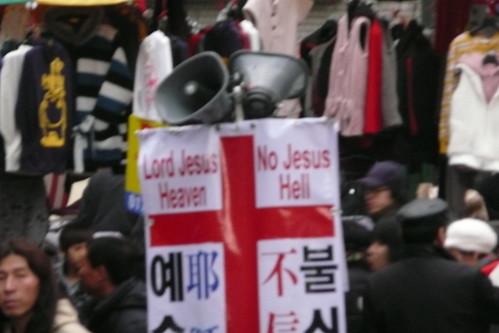
Entrenched in a busy intersection there was a group of about twenty Korean people. One man was screeching into a blown-out microphone in a tone I have only heard from propaganda films or over-excited fruit vendors. As we drew closer I could see they were a Christian group. They carried signs similar to the one below.
Gets right to the point.

I don't speak Korean, but I am guessing that we were being threatened with eternal damnation, ceaseless torment, perpetual suffering, fire and/or brimstone.  In the business world I think it is termed a hard sell.

And this is a pretty common occurrence in Korea. Street demonstrations are only the most attention-grabbing conversion efforts. Live in this country long enough, and you'll encounter some well-meaning evangelists who ask you to attend their church (some standard selling points: English worship services, rockin' social events, lots of pretty girls/handsome dudes). Sometimes a simple "No, thanks," is enough to send them on their way, and sometimes you are stuck in an extremely uncomfortable conversation of interminable length. People are determined to spread the Good Word, and they aren't easily discouraged.

I've yet to see any equivalent actions undertaken by Buddhist groups in Korea. Generally speaking, the most obvious sign of a Korean Buddhist's religious affiliation is the small band of prayer beads, or mala, worn on the wrist. Occasionally you'll see a grey-robed monk wandering the streets for alms, but they don't carry signs or megaphones. They are easy to ignore.

It's not surprising, then, that Christian recruiting efforts have been much more successful in recent years. On the streets of Korean cities, Christianity is a visible and dynamic presence. Buddhism is generally relegated to the home or remote temples, which is to say: out of the realm of public daily life.

If you're a Westerner sympathetic to Buddhism, these trends can be very worrying. We were born and raised in an environment heavily influenced by Christianity, and many of us have become very familiar with its shortcomings. We know about the sexual abuses committed by priests, we've learned about the persecutions carried out by over-zealous missionaries, we are cynical about the corruption and ungodly behavior so often seen at the highest levels of church authority.

It becomes easy to support Buddhism almost blindly. Most of us get out Buddhism-related information through pop cultures. We know that Buddhists are supposed to be super-chill, peaceful types that never get angry and never eat meat. They don't yell, poop, or cheat on their spouses. On the other hand, we've seen Christians do all those nasty things. Buddhists are friendly benign hippies, minus the pot. Christians are intolerant ignoramuses, harshing whatever your buzz happens to be. Familiarity breeds contempt.

Of course, it's not that simple. My girlfriend attends a Buddhist university in Seoul. There are many non-Buddhist students there, just like there are non-Christian students at schools like Notre Dame in the U.S. In any case, one of the Christian student groups recently donated three brand new copy machines to the university's computer lab. A week later, they were mysteriously broken. It was eventually discovered that a group of Buddhist students had tampered with the machines because they were upset at the growing Christian influence at the school. That's a very non-Buddhist thing to do - at the same time, it's very human. We get fearful, we get angry, we lash out.

Anger. Fear. Delusion. The Buddhist teachings are, at their core, a series of trainings for overcoming these obstacles to happiness. We can't be happy if we're scared, pissed off, or confused all the time. But we can't overcome these habits simply by declaring ourselves "Buddhist". It's just a word. It doesn't mean anything. In fact, some of the best "Buddhists" I know aren't Buddhists at all.

Last Saturday, I met a man at a fried chicken restaurant. I never cook on the weekends. It was about 2 a.m., and I'd just returned to Cheonan from Seoul. He invited me to have a beer with him, and I reluctantly accepted. I've been stuck in too many one-sided conversations with Koreans who don't speak English but like to laugh at my long hair and non-proportional faces. I wasn't looking forward to speaking with this
half-drunk ajusshi.


It turned out to be one of the most fascinating conversations I've ever had in Korea. Although his English could generously be described as "broken", the man was an amateur history buff and student of religion. He rattled off a litany of facts about Douglas MacArthur.  He had read Thich Nhat Hanh extensively. He was deeply interested in the Indian tribes of North America. He spoke with kindly admiration about totemism and animism.

He asked me my religion, and I told him that I followed Buddhism. He replied that he was a Catholic himself, but he held deep respect for the Buddhist teachings. It was part of Korea's heritage, he said, and there was a lot of wisdom to be found there. We sat and smiled at each other for a few minutes, occasionally mumbling some remark about the time or weather, and then returned to our homes. A Korean Catholic and an American Buddhist. Weird.

I've been worried about the future of Buddhism in Korea (and all of Asia for that matter). Modern Buddhism is not really a mission-oriented religion. People hold their individual beliefs, but there's little emphasis on spreading those beliefs to others. In theory this should allow Buddhism to coexist peacefully with other religions. And when dealing with Eastern religions such as Hinduism, Jainism, Sikhism, or ancestor worship, this has usually been the case to one extent or the other (with many exceptions of course - religious wars are not an exclusively Western phenomena). Western religions are a bit different though - the major monotheistic religions hold exclusive truth claims. As Christianity begin to make inroads into previously Buddhist countries, will its leaders and practitioners tolerate the old traditions? The tension is high right now - sometimes, it's enough to make you wish for just a little bit more apathy. At least the people who don't care about religion aren't tearing down temples.

On the subject of temples, I visited one the other day. On May 10th Koreans celebrated the Buddha's Birthday. It was a national holiday, apparently, but I didn't see many signs of celebration in the city. Maybe that's good - the Buddha's coming hadn't been commercialized in the same way as Christmas or Easter. Only a few paper lanterns strung up on street signs gave any indication that there was something special going on today.

I'd like to report that the Buddha's birthday was marked by golden beams of sunlight, millions of delicate lotus petals falling from the sky, the harmonious trilling of birds and whatnot, but in actuality the weather was lousy. Grey, overcast, and buckets upon buckets of rain. Climbing up the steep mountain, muddy and wet, I heard the words of my meditation teacher Mark Nunberg in a bemused voice, "Hmmm, this is how it is now. Being clammy and sore is like this. Can this be OK?" And it really was - I was just thrilled to be there. Celebrating the Buddha's birthday at a real temple. Now that's neat.

When we reached the top of the mountain, I forgot that I was ever worried about Buddhism in Korea. In front of the large bronze Buddha statue, people were lighting incense, chanting, and bowing. Thousands of pink, purple, and white lanterns hung from strings crisscrossing the courtyard. Teenagers helped crotchety grandmas across wide puddles, their gnarled hands carrying brightly colored prayer candles. A monk's chants rang out from the main meditation hall, accompanied by the steady beat of a small drum. Inside, people were bowing, meditating, and leaving gifts at the altar of the Buddha. Maybe after that they went home to smoke, drink, gossip, fornicate, or whatever - actually of course they did, they are human. Buddhists aren't perfect. But man, it was a beautiful time, and there was some real joy in being surrounded by like-minded people.

In one hundred years, I hope foreigners are still writing rambling, disjointed essays about Buddhism in Korea. And I hope they remember to bring umbrellas when they visit the temples. That rain can be ruthless.

Tuesday, May 3, 2011

The Shot Heard Halfway 'Round the World

Across the globe, every major news outlet is burning up with a story of tremendous social, political, and historical importance. Meanwhile, Korea is picking up its collective remote and flipping back to that channel where a bunch of dudes play Starcraft.

Unless you've been living under an especially large and sound-proof rock, you've heard the news that Osama Bin Laden was killed yesterday. The event held a lot of significance for many Westerners living in Korea. We remember where we were when the planes hit the World Trade Center, we remember the countless hours of CNN footage, we remember the awful conflicts in Iraq and Afghanistan that ensued.

Osama Bin Laden has been, in many ways, a central figure in the lives of young Westerners. We've been living in a world he helped create, for better or worse. The laws of society changed overnight. The economy took a hit. Thousands of men and women (not much older or younger than ourselves) shipped off around the world for the ostensible purpose of catching the bastard.

Obligingly, we chose sides. Our positions made perfect sense to ourselves and simultaneously sounded like naive bullshit to our opponents.

After 10 years, every viewpoint imaginable has been discussed ad nauseum on one cable network or another. It's hard to imagine a fresh perspective on Osama Bin Laden, Iraq, the War on Terror, etc. Or at least, such a thing is hard to conceive in the West. Here in Korea, nobody seems to give a fuck.

My girlfriend lived in Canada for two years and China for three. She studies international business. If any Korean has a global perspective (i.e. cares about the same things Americans care about), it should be her, right? Nope. She could not have been less enthusiastic when I brought up the subject of Bin Laden's death last night.

"I don't really care one way or another," she said.

I was persistent, though - mainly because I had little else to talk about. Korea is one of the few countries where America is still seen as a "cool" place and a strong ally. Shouldn't this event have some impact on average Koreans? After all, the world is a safer place now...

"This is boring. I don't care. People can be happy or sad or whatever. It's not a big deal in Korea."

When I spoke with a Korean co-teacher this morning, I got the same response. She muttered a few words about hearing about it on the news, and went back to grading papers. None of my kids seemed especially interested in talking about it either - even the older ones, who would normally pull out their own fingernails if it got them out of writing essays.

Korea is an incredibly insular society. 9/11 did not cause the backlash of social problems that it did in the West. They've never dealt with Islamophobia for the simple reason that there are about 50 Muslims living here. Korean airports don't have strip searches and high-powered X-rays to deter nail-clipper wielding hijackers. Terrorist bogeymen don't have much hold on the national psyche because there are much more practical foes to fear, such as the wildly unstable totalitarian dictatorship to the north or the ravenous behemoth that is China.

America had been searching for Bin Laden for a decade. Thousands of people have died in the process, trillions of dollars have been (or will be) expended, and the course of Western history has been shifted onto a strange new course. Supposedly, we have now accomplished one of the primary goals of the war against terrorism.

Korea's reaction is that of a distant aunt who is informed of her nephew's success in a piano competition. She nods politely, offers a few congratulatory words, and returns her attention to matters that are closer and more interesting.

I can't help but feel an odd sense of perspective living here. Korean textbooks will probably never mention May 2, 2011. Bin Laden will cease to be news as soon as the next episode of Superstar K hits the airwaves. And yet back home, people who don't do too many drugs will remember that day for the rest of their lives. Completely divergent narratives, even in a globalized world.

Sometimes even world history isn't that historical.

Friday, April 29, 2011

Some Say It Better

Spoken (or written) language is often a horribly disappointing medium. As an ordinary human being, there are countless times when words are incapable of expressing the power and urgency of a certain feeling. And so the emotions of the moment are blurted out hesitantly or repressed altogether.

The expatriate is an especially susceptible victim of this phenomenon. When you don't speak the language shared by 99.9% of people in close proximity, you're prone to spurts of uncontrollable honesty (often under the influence of stress, lack of sleep, alcohol, loneliness, etc.). The urge to communicate overcomes the obstacles of doing so. Unfortunately for most of us, we're poorly equipped for this task.

I'm often amazed at the unspoken suffering floating amongst foreigners in Korea. Including my own. We're all transplants. All of us running: to something, away from something, or simply in place. Thousands of stories to tell, but very few skilled storytellers. And there's a simple reaction to uninteresting or poorly-told stories - the audience stops paying attention.

You get used to this pretty quickly. 

"Why are you here?"

"Ah, <debt/adventure/boredom>. You know how it goes."

Filler. Pure and simple. You might get close to a handful of people, and the fuzzy picture of their motivations gets a tiny bit clearer. But you're still filling in the blanks of their story for the most part. Meanwhile, people's hearts are straining through their chests, their minds and vocal cords are bursting with a million thoughts and ideas and unfocused feelings, desperate for an outlet, any kind of outlet. We have so much to say, but so few ways to say it.

Try as we might, we just can't find a way to express how we feel. So we turn to musicians, poets, writers, anyone who seems to have a goddamn clue when it comes to communicating human sentiment. We re-read essays and novels for the umpteenth time, we sing the same sad songs at noraebang, we latch on to anyone who has consumed the same literature in the hope that maybe there is some kindred spirit who understands our mindset, even if we can't articulate it.

What if we could just come out once and scream it? "I am ______, and I feel like _________ right now."  Would it be cathartic? Maybe. What about the aftermath? I don't know. Venting is rarely a clean process in real life. 

It seems, then, that storytellers are incredibly important. They say what we wish we could say, only they say it better.

Maybe you're tired and broken,
your tongue is twisted with words half spoken
and thoughts unclear.


What do you want me to do, to do for you
to see you through?
A box of rain will ease your pain
and love will see you through.

~Robert Hunter

Tuesday, April 19, 2011

Race in Korea

I knew something was up when I read the words, "Cow dung huts."

During a staff meeting in January, the teachers were discussing a new project aimed at informing our students about global cultures. The kids were, after all, almost 7 years old. It was about time they memorized the capital cities of Finland, Mozambique, and Papua New Guinea. How else were they supposed to succeed in the cutthroat world of kindergarten education? Valuable berths in prestigious elementary schools were at stake.

We were handed a garishly designed packet of materials. Purportedly, these were intended to facilitate students' learning by providing a quick rundown of the essential facts for about a dozen nations. Through a series of strenuous coloring exercises, the students could learn about the food, clothing, shelter, and environments of each country. Which all sounded perfectly reasonable, until we actually looked at the packet.

One of the countries in question was Kenya. Under the category of "dress", there was a picture of several Kenyan women wearing what appeared to be lion-skin togas. Their ears, noses, lips and eyebrows were full of piercings; their cheeks and foreheads were streaked with paint. It was the same caricature of "dark savage" that convinced 17th century Europeans that full-scale colonization and conversion wouldn't be such a bad thing for Africa.

When it came to housing, our materials were equally unforgiving. According to the packet, Kenyans lived in "cow dung huts". Having never been to Kenya, I'd have a hard time claiming this is unequivocally false. However, look around the streets of Nairobi and you probably won't see bovine feces used as a building material. The most generous thing I could say about the packet is that it was purposefully inaccurate.

Our students, though they are extremely young, already have prejudicial views towards Africans. Anyone who thinks that racism is a major problem in America would be flabbergasted to see its manifestations in Korea. The color of one's skin is incredibly important - the lighter, the better. Hence, the many cosmetic creams that contain bleach to chemically obliterate any trace of pigmentation.

Dark skin is considered "dirty", for reasons that continue to befuddle me (if anything, a tan would help hide the facial blemishes that plague many people here). Old women wear enormous ahjumma visors that flip down in front of their faces like riot police helmets, and it's not unusual to see beach-goers wearing full tracksuits as they splash around in the tide.

It is quite astonishing to see the undisguised scorn that many Koreans, old and young, hold for dark-skinned peoples (especially those from Africa and Southeast Asian countries such as the Philippines or Thailand). My students, who write incredibly endearing notes and give  more unsolicited hugs than a room full of hippies, are also capable of spouting incredibly racist comments that would get them expelled from an American kindergarten. And they have no idea that someone could consider this offensive.

Of course, in a homogeneous society like Korea, one could argue there's no reason to watch what you say or do. Over 99% of people in this country are ethnically Korean. If a TV show features comedians in 1930s blackface and no black people see it, is it offensive?  There are very few big angry black men who would cause a fuss over such jokes. Besides, Koreans never owned African slaves so they have none of the residual guilt/sensitivity that comes with such a stain on a nation's historical record. It makes sense, in a way.

Considering Korea's own unpleasant experience with exploitative colonial powers, though, it's a little surprising to see Koreans so easily stepping into the role of ubermensch. The Japanese occupation (with requisite oppression, deprivation, and wholesale rape of the country) hasn't made the Korean people any more inclined to feel a connection to fellow victims of imperialism.

In my entirely uneducated opinion, I think the recent economic success of Korea has gotten its people a bit high on their own supply (of electronic goods). Put simply: Korea makes refrigerators, cell phones, and affordable mid-size sedans. Africa can't even figure out how to stop everyone from getting AIDS. The memory of poverty fades, and all that's left is a smug sense of superiority and some crotchety old ajusshis.


Americans haven't yet succeeded in getting all creeds and colors to sing Kumbaya under a triple rainbow while enjoying unicorn stew, but life in Korea gives one a greater appreciation for the progress that has been made over the past 50 years. We don't always move quickly or gracefully, but I do believe we are slowly stumbling our way to a better society.

It would be tempting to end this blog post with a grimly condescending analysis of Korea's future, saying something along the lines of:

 "As the former Hermit Kingdom is drawn into the multicultural world of tomorrow, it will need to radically alter its attitudes and policies to cultivate greater equality and tolerance if it wishes to maintain its place as a major economic power."

But in reality, I don't think it really matters (in that sense). Korea is already too damn crowded to accept a massive influx of immigrants. Their electronics-based economy isn't really dependent on the cheap labor that comes from underdeveloped countries, so the demographics aren't likely to shift in a manner that requires a new evaluation of race relations. Koreans marry Koreans, few foreigners move here permanently, and thus the cycle is continued. Korea can enjoy basketball and rap music without having to worry if those menacing black teenagers with baggy pants are going to rob them.

And foreign English teachers will continue to be bemused and slightly offended at all the odd little bits of racism in Korean culture. Like the time our Arts and Crafts project was a black paper-cup "African" with a grass skirt, bulbous eyes, and a Sambo-esque pair of giant grinning red lips that would've made D.W. Griffith say, "Damn, fellas, ain't that a bit much?"

But eh, that's Korea sometimes.

Tuesday, April 12, 2011

Starting Again

I like to paraphrase people, because usually I have a hard time remembering their exact words.

For example: my meditation teacher used to say something to the effect of, "Meditation practice is difficult. You will probably lose focus at least a hundred times during each sit. So, it's important to remember one thing. Don't get discouraged, don't beat yourself up. Just take a deep breath, and be willing to start again."

He was, in my opinion, a pretty smart dude. So I'm going to take his advice with regards to this blogging business. 

I've been in Korea for a little over 8 months now. During that time I've written dozens of emails, hundreds of Facebook posts, and thousands of vaguely inspirational/admonitory notes in my students' diaries. "Keep up the good work, Sally!", or sometimes, "I'm sick of reading that you slept and watched TV on Sunday, Billy, tell me something different next time." However, my blog post count has yet to crack double digits.

When I arrived here I thought I'd be writing far more frequently. This is Asia, after all, and interesting stuff happens all the time here. Not like Minnesota. We have earthquakes, odd restaurant dishes, and cultural misunderstandings galore. If you can't be inspired to write in a place like this, you're probably lacking a pulse.

There's a catch, however - the fundamental difference between being in a place as a visitor, and actually living there. Meditation practice teaches us to be wary of sleepwalking through life. If you're not paying attention it's easy to wake up and go to sleep a few thousand times without really noticing a thing. Vacations are usually great because our surroundings are so unusual that we become deeply curious automatically. 

When your mindset switches from tourist to long-term resident, however, the normalization process kicks in. At least it did in my case (to some extent). You've seen the monuments, you've been to the festivals, you've eaten the live octopus. During a walk to the supermarket, you become accustomed to 99.9% of fellow pedestrians speaking a different language than you.

And after all, you're not being paid to broaden your cultural horizons. Grade reports need to be typed. Supervisors need to be schmoozed. Worksheets need to be written at 8 a.m. for uber-frenetic little weasels who will throw them in the trash can if you turn your back for a second (sometimes they fold the papers into odd little geometric shapes if you're lucky). Before you know it, your exotic adventure has become awfully goddamn ordinary.

Of course, this is all a sly trick of perspective. For most of us plodding through the indefinite midsection of the Korean experience, we're just trying to make a buck (or won) and survive until the weekend when we can enjoy a few hours without wiping up a 5 year old's nosebleed. But to the people back home, our friends and family, we are in the midst of a grand and life-altering adventure.

And they're right. I'm incredibly grateful for every note that says, "Wow, you're in Korea! Bet that's amazing, you're so lucky!" That outside perspective is hugely valuable for shaking us out of our routines. Tthanks folks, for reminding me that there's no need to be a 9 to 5 robot (or in this case a 11:30 to 8 robot with a break in the afternoon). The big picture is where it's at - get hung up on the details and it's a long, slow, boring trip. We're in Korea, we're basically getting paid for speaking our native language, and we get to bum around Asia a couple times each year. Life's good.

It's April 12 and I'm back in the blog-writing saddle. I'll be making a conscious effort to make a consistent effort. It might not work all the time. But I'm confident that no matter how many times I get stuck, I'll find a way to start again. Like Robert Hunter once said, they can't revoke your soul for tryin'.

(Or something like that.)


Tuesday, December 7, 2010

Education in Korea

"What are you doing this weekend?"
"We study for English test."
"What else are you doing this weekend?"
"Nothing."

Usually, this sort of exchange would evoke a feeling of something between exasperation and resignation from any decent ESL/EFL teacher: "Just learn the damn vocab words already - how hard is it to say, 'I'm going to the mall?!'" However, in mid-December, a response of this kind (linguistically lazy as it may be) is not far from the truth in Korea. It's final exam time, baby!

Korea's educational system is a curious hybrid of Eastern and Western influences. By no means am I an expert; it would take many years of research (and a hefty grant, if anyone is really interested) to really understand the cultural, economic, and political gametes that birthed this curious creature.  But, as a hagwon teacher whose assigned homework is constantly neglected in favor of test preparation, I have had some interesting encounters with this beast.

Standardized testing has not been popular in the U.S. for as long as I can remember. This is somewhat to my chagrin, because I did pretty well on tests in school (with the notable exception of anything involving mathematics). The argument generally proceeds something like this: 

"Who made the tests? Are they prejudiced against certain socioeconomic groups? How do you know kids from different schools will be properly prepared for the test? Will we have to reorganize an entire year's curriculum? Why should a few hours with a bubble sheet and #2 pencil trump months of classroom experience and active learning? Tests don't really measure how smart a kid is, or how much s/he has learned anyway. This just measure how well a kid can take a test."

That sort of logic has not made its way to Korea just yet. Tests of all kinds are hugely important here. Korea is in the midst of a massive capitalism binge, and if there's one thing that capitalism loves, it's raw numbers. Numbers aren't subjective, numbers don't lie, numbers don't force you to muddle into that misty grey area between "good" and "bad". Everything can be smoothly quantified to aid analysis of future success:How many answers did you get wrong? How many did you get right? How many students scored below (or above) you? Standardized tests provide neat, tidy answers to these neat, tidy questions. 

On one hand, it seems like this approach makes sense. Korea has gone from a struggling backwater noted worldwide only for a brief conflict between Communism and Democracy in the 1950s (even that war was dubbed "Forgotten" in the American lexicon) to one of the world's most rapidly growing economies. Companies like Samsung, LG, and Hyundai have accumulated Scrooge McDuckian profits thanks to graduates of the test-focused Korean educational system. Which, coincidentally, is closely related to the Chinese educational system. And it seems like China has made the news once or twice for its economic growth...

So if there is a Sonata in every car-port and rice in every wok, what's the problem? Why argue with success? After all, it's not like the U.S. educational system is getting many gold stars for its effectiveness lately. Every month you can open the newspaper and see another alarming statistic - American middle schoolers are #25 in the world in reading comprehension, kindergarteners are 64th in math, U.S. universities are producing fewer biophysicists than Lichtenstein, etc.

But Korean education (and society in general) is about to encounter some serious challenges of its own. I hear it from friends studying architecture at Korean universities - students are so focused on achieving top marks that they'd rather copy the designs of established architects than attempt to create an original design of their own. I hear it from Korean students recently returned from studying abroad - they're no longer encouraged to be creative, but rather to imitate precisely crafted formulas for reports, essays, and projects. I hear it from Korean educators themselves - plagiarism is so widespread that it's not even considered a problem. It would be like a fish complaining that the ocean is too wet.

In short, it seems likely that in the next few decades Korea will be suffering from a serious shortage of creativity. Much like Japan, whose insanely propserous 1980s and 1990s gave way to a new millennium marked by a sluggish economy and nation-wide existential funk, Korea will have to decide if its emphasis on memorization and imitation (so useful for creating a short term economic boom) can be adapted to achieve long term success. When the old ideas cease to be profitable, who will come up with new ones? A nation needs mechanical engineers, to be sure, but it also needs dreamers.

When my kindergarteners color pictures in their workbook, I let them know it's OK to be silly. Sometimes their creations are quite imaginative - women with gigantic purple beehive hairdos, fire-breathing giraffes with wings, restaurant menus with arms and legs. Other times, they draw big steaming piles of poop all over the page.

I like to think I'm doing my part to inspire the future creative geniuses of Korea.